
Grease Trap Cleaning, Installation and Repair in San Francisco and the East Bay
A grease trap catches fats, oils, and grease in kitchen drains so they don’t reach the sewer. When it's full or damaged, grease can get into your pipes and the city's. That slows down or clogs drains, and inspectors start asking questions.
R&L Plumbing handles grease trap cleaning, repair, and installation for restaurants, cafes, commercial kitchens, and mixed-use buildings in San Francisco and the East Bay. We take calls 24/7.
Grease Trap Services at a Glance
| Service | What it covers |
|---|---|
| Grease trap cleaning | Removing built-up grease, food solids, and sludge, then checking that the trap works the way it should |
| Maintenance plans | Cleanings on a schedule that fits your kitchen and your permit |
| Installation and upgrades | New traps for buildouts and bigger equipment when a kitchen outgrows the old one |
| Repair | Fixing damaged baffles, lids, seals and connecting pipes |
| Compliance support | The work and paperwork FOG inspectors look for |
| Emergency service | 24/7 help for overflows and grease backups |
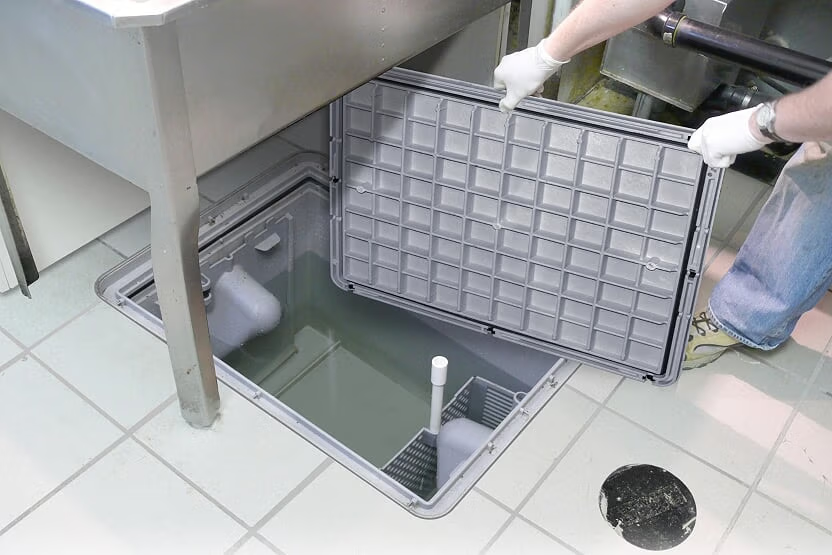
What's the Difference Between a Grease Trap and a Grease Interceptor?
People often use the terms interchangeably, but they're not quite the same thing.
| Type | Where it sits | Good to know |
|---|---|---|
| Grease trap | Under or next to a sink in the kitchen | Smaller, so it fills and needs cleaning more often. Also called a hydromechanical grease interceptor. |
| Grease interceptor | Usually in the ground outside or below the kitchen | Much larger and pumped out by truck. SFPUC notes big gravity interceptors often won't fit SF restaurant sites. |
| Grease removal device (GRD) | Under or near a sink | Skims grease out automatically. A common choice in SF kitchens without room for an interceptor. |
What Are Signs Your Grease Trap Needs Service?
- Kitchen sinks and floor sinks draining slower than usual
- A sour grease smell near the drains or the trap lid
- Water backing up into floor drains during a busy service
- Grease or food bits showing up in the cleanout past the trap
- Your maintenance log says a cleaning is due
- An inspector noted a problem on their last visit
A slow floor sink could mean a full trap, a clog in the line past it, or a problem with the trap itself. The fix depends on which one it is. That's the first thing we check.
How Do San Francisco's Grease Rules Work?
San Francisco's utility, the SFPUC, enforces a FOG Control Ordinance for restaurants and other food businesses. If your kitchen cooks food, the city requires grease capturing equipment like a trap or interceptor.
SFPUC inspectors visit and assign each business a FOG discharger category from 1 to 3 based on how much grease it's likely to send down the drain. Your category determines what equipment you need and how it has to be kept up. Places that only reheat food or assemble ready-to-eat items fall under Category 4, which is exempt.
SFPUC also provides resources to help businesses meet these requirements and offset some of the cost.
- SFPUC publishes free maintenance log forms for grease traps and grease removal devices.
- If you're required to add a grease removal device, SFPUC offers lease and loan options to help with the cost.
- Eligible businesses can also receive a 14.2% reduction on the sewer service portion of their bill after installing approved grease-capturing equipment and submitting SFPUC’s Installation Verification Form.
The SFPUC FOG Control page has the category checklist and fact sheets. We can handle the cleaning, repair, or install your category calls for.
What About Grease Rules in the East Bay?
East Bay grease rules come from the city or sanitary district your sewer connects to. So they change from town to town.
Near our San Lorenzo office, that's often the Oro Loma Sanitary District. It serves San Lorenzo, Ashland, Cherryland, Fairview and parts of San Leandro, Hayward and Castro Valley. Oro Loma Ordinance 39-11 requires grease interceptors for commercial users when they're needed, and section 4.6.1 covers maintenance and best practices. Food businesses in the district also have to enroll in Swift Comply, an online system Oro Loma uses to track grease control devices.
The details are on Oro Loma's F.O.G. page. In another district? Check with them or ask us when you call.
How Often Should a Grease Trap Be Cleaned?
Every kitchen is different. It depends on the size of the device, your menu, and how busy you are. A small trap under a fry-heavy line fills a lot faster than a big interceptor behind a coffee shop.
Start with what your permit or inspector requires. Log every cleaning. And if the trap keeps filling before the next scheduled visit, clean it sooner.
When Does a Kitchen Need a New Grease Trap?
- A new restaurant buildout
- A menu change that adds fryers, grills, or woks
- An inspector says your current equipment isn't enough
- The old trap is cracked, corroded, or worn out
A lot of San Francisco kitchens are small, so the device has to fit in the space as well as the rules. We look at your drains, menu, and local requirements, then recommend equipment that fits all three.
Keep Grease Out of the Drain Between Cleanings
Your grease trap stays cleaner longer when staff helps keep grease and food waste out of the drains.
- Scrape plates and pans into the trash or compost before washing
- Collect used fryer oil for recycling and keep it out of every drain
- Keep strainers in sinks and floor drains
- Wipe greasy pots with a paper towel before they hit the sink
- Show new staff the routine when they start
SFPUC also has tips for disposing of used cooking oil if you need a recycling option.
Grease Trap Service for Property Managers
Grease doesn't stay in one unit. In a mixed-use building, a restaurant tenant's grease can build up in shared lines and back up into other spaces.
We work with property managers to service tenant’s traps and keep shared lines clear. If grease has already built up in the pipes, hydro jetting can clear it. A sewer video inspection can help show how far the buildup goes.
Common Grease Trap Questions
Who's responsible for the grease trap, the restaurant or the landlord?
Check your lease. It should say who handles cleaning and repairs. We can work with either the tenant or the owner.
What should I do if my grease trap overflows?
Stop running water to the kitchen sinks and dishwasher so you don't add more. Keep staff away from the wet floor. Then call us at (415) 651-4977; we take calls 24/7.
Can you help me get ready for a FOG inspection?
Yes. We can clean and repair your trap before the visit. Your invoice shows the work, so you can add it to your maintenance log.
Can a grease trap cause a sewer backup?
Yes. If a trap is full or broken, grease can pass through and build up in downstream pipes, potentially contributing to a sewer backup.
Can I get a quote before booking service?
Yes. We offer a free consultation to look at your setup and talk through options.
Book Grease Trap Service With R&L
Call (415) 651-4977, text us, or schedule online. Let us know your quieter hours when you book.
(415) 651-4977 · Available 24/7
San Francisco Office · 275 Clara St., San Francisco, CA 94107
San Lorenzo East Bay Office · 16848 Alisal Ct., San Lorenzo, CA 94580
Lic# 1073041 C36 Plumbing · Lic# 1114298 C20 HVAC · Lic# 1126752 B General Building
Grease Traps
At R&L Plumbing, we are dedicated to providing our customers with quality work and friendly customer service. All of our products come with a warranty and guaranteed satisfaction. For more information or to schedule an appointment, call us, text us, or schedule online.